
Dear cortex, we need to talk about what the amygdala's been doing. Also the thalamus. Also the insula. Everyone has been theatrical lately. A sore paw starts as a tiny civic grievance, then the brain turns it into repertory theater: heightened touch, cold sensitivity, anxiety, the works. Pain, like bad cinema, sometimes refuses to stay in its lane.
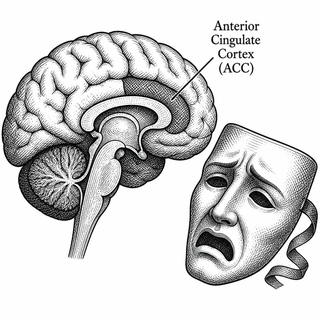
The Brain's Little Pain Theater
Shimoyama and colleagues studied what happens in mice after peripheral inflammation, asking a deceptively simple question: what if prostaglandins, those lipid messengers famous for stirring inflammation in the body and spinal cord, are also meddling upstairs in the cortex? Their answer points to the anterior cingulate cortex, or ACC, a region near the brain's midline that attaches emotional meaning to trouble. The ACC is not merely asking, "Does this hurt?" It is asking, "What does this say about my entire future as a creature with paws?"
The team found that lipocalin-type prostaglandin D synthase, or L-PGDS, rose in the ACC after inflammation. That enzyme helps make prostaglandin D2, or PGD2. PGD2 then signals through a receptor called DP1. If this sounds like a bureaucratic chain of command, that is because biology adores middle management.
A Chemical Whisper Turns Into a Shout
The elegant trouble is this. In the inflamed mice, excitatory glutamate signaling became stronger in two ACC-bound pathways: one from the thalamus, a sensory relay with the confidence of a switchboard operator, and one from the insula, a region involved in bodily feeling and emotional salience. The ACC received the message with extra volume.
When the researchers blocked DP1 receptors inside the ACC, those enhanced synaptic responses calmed down. Even better, the mice showed less mechanical hypersensitivity, less cold hypersensitivity, and fewer anxiety-like behaviors after inflammation Shimoyama et al., 2026. In other words, this was not just chemistry doing interpretive dance in a dish. It connected to behavior.
The upstream mechanism matters, too. Activating NMDA receptors and adenylyl cyclase 1, or AC1, promoted L-PGDS production. NMDA receptors let neurons change with experience, like tiny actors who insist on rewriting the script after every performance. AC1 has long appeared in pain-plasticity work, so finding it tied to cortical PGD2 gives the story a satisfying, slightly suspicious symmetry.
Why This Is More Than Mouse Melodrama
Chronic pain is rarely only a volume knob for sensation. It comes with dread, sleep disruption, irritability, and that miserable little mental weather system called anticipatory anxiety. Recent work has been pushing pain science away from a simple wire model and toward networks: ACC, insula, amygdala, thalamus, claustrum, striatum, all exchanging neuronal text messages nobody requested.
That broader picture fits this paper. A PNAS study showed that ACC pain coding depends on population activity rather than a single mythical "pain neuron," which is scientifically sensible and emotionally disappointing, because villains are easier when they have one address Acuna et al., 2023. Other mouse studies have linked chronic pain states to altered claustro-cingulate signaling Ntamati et al., 2023 and amygdala-to-ACC activity tied to depression-like behavior Becker et al., 2023.
PGD2 adds another layer: immune-flavored chemistry inside emotional pain circuitry. That fits with work showing that microglial activation can drive negative affect through prostaglandin synthesis in striatal neurons Klawonn et al., 2021. Prostaglandins are familiar drug territory, but the usual anti-inflammatory story mostly happens outside the cortex. Here, the suggestion is sharper. The inflamed body may teach the cortex to overreact, and PGD2-DP1 signaling may help write that lesson in synapses.
The Promising Part, With a Lab-Coat Raised Eyebrow
If these results reproduce and expand, the real-world hope is not "take this tomorrow and become pain-free by lunch." Biology hates tidy marketing. The hope is more refined: during early inflammation, targeting cortical PGD2-DP1 signaling might reduce the chance that pain becomes paired with anxiety and sensory hypersensitivity. It could become part of a strategy to stop pain from becoming a learned, emotionally charged habit.
But the caveats are not decorative. This was a mouse study, largely framed around male animals, and pain-behavior experiments demand rigor because translation has been painfully uneven Sadler et al., 2022. Mouse anxiety tests are useful but not identical to a human lying awake at 3:12 a.m. over one ominous twinge. Delivering drugs selectively to cortical DP1 pathways is also no small task. The brain is not a kitchen drawer where you can rummage around until you find the good scissors.
Still, the study gives pain research a vivid clue. The cortex is not a passive audience watching inflammation unfold below. It may be a co-director, adding lighting, music, and unnecessary emotional subplots. And if PGD2 is one of the stage managers, then perhaps one day we can ask it, politely but firmly, to stop cueing the anxiety music.
References
Shimoyama S, Ishikawa T, Oke Y, Kawabata R, Ozaki N, Ueno S, Noguchi K, Zhuo M, Koga K. Cortical prostaglandin D2 contributes to behavioral sensitization and anxiety in peripheral inflammation. Cell Reports. 2026;45(6):117492. https://doi.org/10.1016/j.celrep.2026.117492
Sadler KE, Mogil JS, Stucky CL. Innovations and advances in modelling and measuring pain in animals. Nature Reviews Neuroscience. 2022;23:70-85. PMCID: PMC9098196. https://doi.org/10.1038/s41583-021-00536-7
Klawonn AM, Fritz M, Castany S, et al. Microglial activation elicits a negative affective state through prostaglandin-mediated modulation of striatal neurons. Immunity. 2021;54:225-234.e6. https://doi.org/10.1016/j.immuni.2020.12.016
Acuna MA, Kasanetz F, De Luna P, Falkowska M, Nevian T. Principles of nociceptive coding in the anterior cingulate cortex. Proceedings of the National Academy of Sciences. 2023;120(23):e2212394120. PMCID: PMC10265977. https://doi.org/10.1073/pnas.2212394120
Ntamati NR, Acuna MA, Nevian T. Pain-induced adaptations in the claustro-cingulate pathway. Cell Reports. 2023;42(5):112506. PMCID: PMC10242445. https://doi.org/10.1016/j.celrep.2023.112506
Becker LJ, Fillinger C, Waegaert R, et al. The basolateral amygdala-anterior cingulate pathway contributes to depression-like behaviors and comorbidity with chronic pain behaviors in male mice. Nature Communications. 2023;14:2198. PMCID: PMC10110607. https://doi.org/10.1038/s41467-023-37878-y
Disclaimer: The image accompanying this article is for illustrative purposes only and does not depict actual experimental results, data, or biological mechanisms.