
People love saying the brain "runs on sugar" like glucose is some flawless franchise quarterback that never throws picks. Nice myth. This paper shows that too much glucose can absolutely fumble the ball - especially in the hippocampus, the brain region that helps you form memories and keep your mental playbook organized.
A new study in Cell Reports looks at why cognitive problems can show up in type 2 diabetes, and it lands on a surprisingly specific culprit: a chemical tag called lactylation that gums up a mitochondrial enzyme named HSD17B10. Once that enzyme gets tagged in the wrong spot, neurons start piling up lipid droplets - little fat storage blobs - and that metabolic traffic jam appears to help drive cell death and memory trouble in diabetic mice. The researchers also found that the same molecular signal in human blood predicted cognitive dysfunction in people with type 2 diabetes. That is not nothing.
The brain's storage closet is not supposed to look like this
Let's translate the biochemistry before it starts acting like it owns the room.
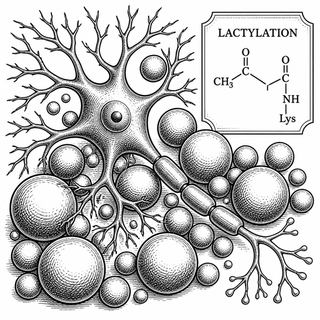
Under healthy conditions, neurons are metabolic divas. They need a lot of energy and usually don't like storing extra fat. Lipid droplets can be useful in some situations, but if they build up too much, that's often a sign the cell's housekeeping crew is getting outworked. Think less "well-stocked pantry" and more "garage so full you can't find the lawnmower."
This paper argues that high glucose pushes neurons into that cluttered state through a chain reaction:
- High glucose increases Aars1, described here as a lactyltransferase.
- Aars1 adds a lactyl group to HSD17B10 at a specific site, K105.
- That modification lowers HSD17B10 enzyme activity.
- Fat breakdown falters, so lipid droplets accumulate.
- Neurons become more likely to die, especially in the hippocampus.
- Cognitive function slips.
That's the whole drive down the field. One bad handoff leads to another.
Wait - what even is lactylation?
Lactylation is a relatively new kind of post-translational modification, which is science-speak for "cells editing proteins after they've already been built." If phosphorylation is the celebrity everyone knows, lactylation is the newer player scouts started noticing after a few weirdly good games.
It's linked to lactate, a molecule best known from metabolism. For years lactate got treated like metabolic exhaust - the biochemical equivalent of gym-sock steam. But research over the last several years has made that story way more interesting. Lactate can act as a fuel, a signal, and apparently part of the cell's protein-editing toolkit too. Reviews and recent studies suggest lactylation may influence inflammation, metabolism, and brain disease, though a lot of that playbook is still being written (Zhang et al., 2024; Huang et al., 2023).
So this study asks a sharp question: if diabetes changes glucose and lactate metabolism, could it also change protein lactylation in neurons in a way that damages cognition? Short answer: that seems to be exactly what happens here.
The key player with the unpronounceable name
HSD17B10 is one of those enzymes that sounds like a Wi-Fi password but matters a lot. It's a mitochondrial protein involved in metabolic pathways, including fatty acid-related processing. The mitochondria, of course, are the cell's energy plants - yes, I know, every biology class has said that since the Bronze Age, but occasionally the cliché is useful.
In this study, HSD17B10 seems to help keep neuronal fat handling under control. But when high glucose drives K105 lactylation, the enzyme loses function. Then the neuron starts storing lipid droplets like it's panic-buying during a snowstorm.
That matters because abnormal lipid droplet accumulation has increasingly been linked to neurodegeneration and cellular stress. Recent work suggests lipid droplets can be protective in some contexts but harmful in others, especially when they signal mitochondrial dysfunction or failed lipid clearance (Farmer et al., 2020; Pennetta and Welte, 2022).
The sneaky part: they may have found both a marker and a play to run
The most intriguing piece here is not just the mechanism. It's that the researchers tested a short peptide designed to block HSD17B10 K105 lactylation, and it improved cognitive outcomes in diabetic mice.
That doesn't mean we're about to get a miracle memory shot for diabetes next Tuesday. Mice are not tiny hairy patients with union representation. But it does mean this pathway might be druggable, which is the kind of phrase that makes translational neuroscientists sit up straighter.
Even more interesting, the study reports that elevated plasma HSD17B10 K105 lactylation predicted cognitive dysfunction in a large prospective cohort of people with type 2 diabetes. If that finding holds up, this could become part of a blood-based warning system - a biochemical early scouting report for who might be headed toward cognitive trouble.
And that would matter a lot. Type 2 diabetes has already been linked to increased risk of cognitive decline and dementia in multiple studies and reviews (Biessels and Despa, 2018; Tumminia et al., 2024). What's been missing is a clean molecular bridge between high blood sugar and damaged neurons. This paper offers one.
What this could mean in real life
If the results are reproducible and extend to humans, this line of research could eventually help in three ways:
- Earlier detection - spotting diabetic patients at higher risk for cognitive decline
- Targeted treatments - blocking harmful lactylation instead of just reacting after symptoms appear
- Better prevention - understanding how metabolic stress injures the brain at the cellular level
That last point matters because diabetes-related cognitive impairment often feels vague until it doesn't. Trouble concentrating. Forgetfulness. Slower thinking. It's the kind of change people can blame on stress, age, sleep, or having 47 tabs open in their head at all times. A biomarker could make that fog easier to catch before it thickens.
The replay booth
This is one study, and it makes a strong case without ending the game. We still need replication, mechanistic follow-up, and a better sense of whether this pathway drives disease broadly or marks one important subset of patients. We also need to know whether changing lactylation safely in humans is realistic.
Still, this is a clever piece of work. It ties together glucose overload, protein chemistry, fat metabolism, neuron survival, mouse behavior, and human cohort data in one story. That's a lot of moving parts, and here they line up like a well-coached two-minute drill.
The broader lesson is simple: the brain doesn't just suffer from high sugar in some vague, abstract way. It gets hit through specific molecular mistakes. And sometimes one tiny chemical tag is all it takes to send the offense completely off script.
References
Xu J, Cao J, Yang X, et al. High glucose impairs cognitive function by inducing lipid droplet accumulation through lactylation of HSD17B10 at K105. Cell Reports. 2026;117550. doi:10.1016/j.celrep.2026.117550
Biessels GJ, Despa F. Cognitive decline and dementia in diabetes mellitus: mechanisms and clinical implications. Lancet Neurol. 2018;17(2):174-184. doi:10.1016/S1474-4422(18)30002-2
Tumminia A, Vinciguerra F, Parisi M, et al. Type 2 diabetes mellitus and cognitive decline: current concepts and future perspectives. Biomedicines. 2024;12(1):176. doi:10.3390/biomedicines12010176
Zhang D, Tang Z, Huang H, et al. Protein lactylation in metabolism and disease. Trends Cell Biol. 2024. doi:10.1016/j.tcb.2024.01.002
Huang H, et al. Lactylation: a new posttranslational modification in health and disease. Cells. 2023. PMCID:PMC10169774
Farmer BC, Walsh AE, Kluemper JC, Johnson LA. Lipid droplets in neurodegenerative disorders. Trends Neurosci. 2020;43(9):702-715. doi:10.1016/j.tins.2020.03.006
Pennetta G, Welte MA. Emerging links between lipid droplets and motor neuron diseases. Annu Rev Cell Dev Biol. 2022;38:221-245. doi:10.1146/annurev-cellbio-120219-024405
Disclaimer: The image accompanying this article is for illustrative purposes only and does not depict actual experimental results, data, or biological mechanisms.