
Maps can betray you.
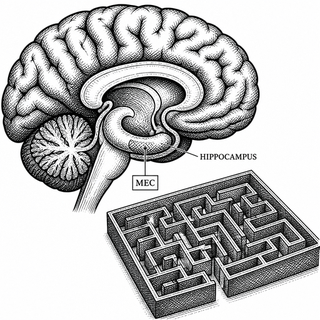
I have been thinking about that small betrayal, the one where a familiar room suddenly feels badly lit from the inside. That is the territory of a new Cell Reports paper: not simply whether amyloid-beta plaques exist, but whether they make the brain's inner map smear like wet ink. In 18-month-old APP knock-in mice, Rodriguez and colleagues asked what advanced amyloid pathology does inside the medial entorhinal cortex, or MEC (Rodriguez et al., 2026).
The Brain's Tiny Map Studio
The MEC sits near the hippocampus and helps sketch where you are in space. It is famous for grid cells, neurons that fire in repeating patterns as an animal moves around, like someone laid graph paper over the world and then gave it caffeine. Other cells care about borders, direction, speed, and the general "you are approximately here, please stop walking into the sofa" problem.
This mapping system is not decorative. Recent work shows that a consistent MEC map supports spatial memory, while disrupted grid-cell networks have appeared in Alzheimer-like mouse models (Malone et al., 2024; Ying et al., 2022). If this map gets unstable, you get the sort of philosophical problem where you lose your car in a parking lot and blame the architect.
What the Mice Revealed
The team recorded single neurons while aged APP knock-in mice explored open-field arenas. These mice carry disease-linked changes in their own App gene, rather than simply overproducing amyloid precursor protein like a factory with the thermostat broken. That makes them useful for asking what amyloid pathology does to circuits under closer-to-normal gene regulation.
The answer was not subtle. MEC neurons in APP knock-in mice carried less spatial information. Grid-cell periodicity was disrupted. Border-cell preferences became unstable across sessions. When the researchers used spatial decoding, the neuronal activity did a worse job predicting where the mouse was and how fast it was moving. Even the rate maps, those lovely little heat maps of where cells fire, became more unstable by an Earth Mover's Distance analysis. That measure has a wonderfully literal name: imagine comparing two piles of neural dirt and asking how much shoveling it takes to turn one into the other. Science occasionally names things like a tired landscaper, and I respect it.
There was another twist. The APP knock-in mice showed mild neuronal hyperactivity, driven mainly by narrow-spiking putative interneurons. Interneurons usually help tune and restrain circuits, the brain's fussy copy editors. If they start firing oddly, the whole map can read like a sentence with every comma moved three words to the left.
Plaques Are Not the Whole Painting
The paper matters because it connects amyloid pathology to the actual language of neurons: spikes, maps, stability, decoding. Alzheimer's research has often stared hard at plaques and tangles, which makes sense because they are visible and suspicious-looking, like fingerprints at a crime scene. But memory and navigation fail through circuits. Plaque counts alone cannot tell you whether the brain's map is still legible.
That circuit view fits with a broader shift. Human imaging work suggests amyloid and tau relate to altered brain rhythms before obvious symptoms, with amyloid linked to faster activity and tau helping push the system toward slowing (Gallego-Rudolf et al., 2024). Other human-network work places the entorhinal cortex near the opening act of tau spread (Lee et al., 2022). And mouse studies suggest that targeting amyloid-linked hyperactivity can rescue some early circuit dysfunction (Zott et al., 2024). The emerging picture is less "one villain, one weapon" and more "bad lighting, unstable scaffolding, and the orchestra is tuning during the performance."
Why This Could Matter Later
If these findings replicate and extend to humans, they point toward earlier, more functional readouts of disease. Spatial navigation tests, brain rhythm measures, and circuit-level biomarkers might catch trouble while the map is still smudged rather than shredded. Treatments might also need to stabilize network activity, protect synapses, and preserve map consistency, not only sweep up amyloid after the party has already destroyed the carpet.
There are caveats, because biology is contractually obligated to be annoying. These are mice, not tiny people with appointment calendars. The study uses advanced amyloid pathology in a specific model, while human Alzheimer's includes tau, inflammation, vascular changes, aging, genetics, and probably several molecular side quests we have not named yet. Still, it gives us a sharp little window into how disease-associated protein burden can bend the brain's spatial sketching machinery.
And that is the unsettling beauty here. The brain does not just store places. It paints them, layer by layer, with electrical brushstrokes. In these mice, amyloid pathology seems to make the brush twitch.
References
Rodriguez GA, Aoun A, Rothenberg EF, Shetler CO, Posani L, Vajram SV, Tedesco T, Sharma A, Fusi S, Hussaini SA. Impaired spatial coding and neuronal hyperactivity in the medial entorhinal cortex of aged APP knock-in mice. Cell Reports. 2026;45(6):117505. https://doi.org/10.1016/j.celrep.2026.117505
Ying J, Keinath AT, Lavoie R, et al. Disruption of the grid cell network in a mouse model of early Alzheimer's disease. Nature Communications. 2022;13:886. https://doi.org/10.1038/s41467-022-28551-x
Malone TJ, Tien NW, Ma Y, et al. A consistent map in the medial entorhinal cortex supports spatial memory. Nature Communications. 2024;15:1457. https://doi.org/10.1038/s41467-024-45853-4
Gallego-Rudolf J, Wiesman AI, Pichet Binette A, et al. Synergistic association of amyloid-beta and tau pathology with cortical neurophysiology and cognitive decline in asymptomatic older adults. Nature Neuroscience. 2024;27:2130-2137. https://doi.org/10.1038/s41593-024-01763-8
Lee WJ, Brown JA, Kim HR, et al. Regional amyloid-beta-tau interactions promote onset and acceleration of Alzheimer's disease tau spreading. Neuron. 2022;110(12):1932-1943.e5. PMCID: PMC9233123. https://doi.org/10.1016/j.neuron.2022.03.034
Zott B, Nastle L, Grienberger C, et al. Beta-amyloid monomer scavenging by an anticalin protein prevents neuronal hyperactivity in mouse models of Alzheimer's disease. Nature Communications. 2024;15:5819. https://doi.org/10.1038/s41467-024-50153-y
Disclaimer: The image accompanying this article is for illustrative purposes only and does not depict actual experimental results, data, or biological mechanisms.