
You're using this right now: the motor system that lets your eyes hop across this sentence, your hand steady the phone, and your face make that tiny "huh, brains are ridiculous" expression. There is an old saying that still waters run deep, but in neurology the still hand can sometimes be the loudest drummer in the room. A new Cell Reports study suggests that rest tremor and action tremor may keep time with different networks inside the primary motor cortex [1].
Same Shake, Different Mischief
Tremor is not just "shaking." Clinicians pay close attention to when it happens. Rest tremor shows up when a body part is relaxed, the classic Parkinson's hand tremor that can appear while someone is sitting quietly. Action tremor barges in while a person is doing something, like drinking from a cup, writing a check, or attempting soup without turning lunch into modern art.
That difference matters because Parkinson disease and essential tremor can both involve disabling tremor, and both can improve with deep brain stimulation, or DBS. DBS is basically a pacemaker for brain circuits, except the wiring diagram was drawn by evolution after three coffees and no ruler. The goal is to disrupt the pathological rhythm without annoying nearby circuits that were minding their own business.
The Motor Strip Is Not a Piano Keyboard
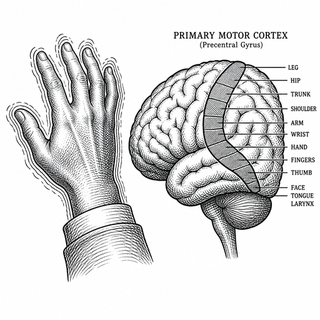
For decades, people pictured the primary motor cortex as a tidy body map: foot here, hand there, face over yonder. The famous motor homunculus is useful, but it also looks like someone asked a potato to draw a tiny person from memory. Then 2023 work described "inter-effector" regions tucked between the classic foot, hand, and mouth zones. These areas seem less about one finger doing one thing and more about whole-body coordination [2].
Goede and colleagues asked a sharp question: when DBS helps tremor, do rest and action tremor split the bill?
They used DBS network mapping across multiple patient cohorts, including people with Parkinson disease and essential tremor. The punchline: rest tremor linked more strongly to effector-specific regions, the classic "this body part has a desk here" zones. Action tremor leaned toward inter-effector territories, the coordination-heavy regions that help organize movement across body parts [1].
Why This Is a Big Deal in Ordinary Human Terms
If this finding holds up, it gives clinicians a better map for programming DBS. Today, DBS tuning can involve careful trial and error. That is not because doctors are winging it like a jazz trio in lab coats; it is because every brain is slightly different, symptoms overlap, and electrical fields spread through tissue in complicated ways. One patient may care most about a tremor at rest. Another may care most about getting a fork to the mouth without reenacting a tiny catapult disaster.
The new study suggests those goals might need different network targets. Rest tremor may benefit when stimulation engages more specific motor zones. Action tremor may need broader coordination territory. That fits with other recent work showing that DBS effects are network effects, not just "zap this one dot and call it a day" effects. A 2024 Nature Communications study tied tremor improvement to tracts connected to primary motor cortex and cerebellum [3]. A 2025 study mapped a cross-condition tremor treatment network spanning Parkinson disease and essential tremor [4].
The Brain Loves Committees
The deeper theme is that tremor may not live in a single guilty brain region wearing a tiny villain cape. It may emerge from circuits: cortex, thalamus, basal ganglia, cerebellum, and their chatty little loops. Neurons are tiny gossip networks, and when the wrong rumor gets rhythmic, your hand may hear about it.
That circuit view also connects to newer work on the somato-cognitive action network, or SCAN. In 2026, Ren and colleagues argued that Parkinson disease involves abnormal connectivity in this action-control network, and that effective treatments can reduce that abnormal coupling [5]. In plain English: symptoms may reflect disrupted coordination between movement, intention, body state, and control systems.
The Sensible Excitement Zone
This is not a cure, and it does not mean every DBS patient should have settings changed tomorrow morning before breakfast. Network maps still need validation and prospective testing. But the direction is practical: program stimulation based on the tremor someone actually has, not merely the diagnosis stamped on the chart.
That could matter in ordinary life. Tremor can make handwriting, shaving, eating, dressing, and public confidence feel like daily negotiations with an uncooperative metronome. If clinicians can better separate the circuits for tremor at rest from tremor during action, DBS programming could become more precise, faster, and more symptom-specific. Not magic. Better wiring logic.
References
- Goede LL, Zvarova P, Madan S, et al. Action and rest tremor map to distinct networks within the primary motor cortex. Cell Reports. 2026;45(6):117404. https://doi.org/10.1016/j.celrep.2026.117404
- Gordon EM, Chauvin RJ, Van AN, et al. A somato-cognitive action network alternates with effector regions in motor cortex. Nature. 2023;617:351-359. https://doi.org/10.1038/s41586-023-05964-2
- Rajamani N, Friedrich H, Butenko K, et al. Deep brain stimulation of symptom-specific networks in Parkinson's disease. Nature Communications. 2024;15:4662. https://doi.org/10.1038/s41467-024-48731-1
- Goede LL, Al-Fatly B, Li N, et al. Convergent mapping of a tremor treatment network. Nature Communications. 2025;16:4772. https://doi.org/10.1038/s41467-025-60089-6
- Ren J, Zhang W, Dahmani L, et al. Parkinson's disease as a somato-cognitive action network disorder. Nature. 2026;651:1030-1038. https://doi.org/10.1038/s41586-025-10059-1
Disclaimer: The image accompanying this article is for illustrative purposes only and does not depict actual experimental results, data, or biological mechanisms.