
A championship brain does not win because one superstar neuron takes every shot. It wins because the team learns the playbook: neurons are the players, synapses are the plays, and the prefrontal cortex is the coach with a marker-stained whiteboard saying, "Okay, if blue plus square means snack, but green plus square also means snack, what are we even running here?"
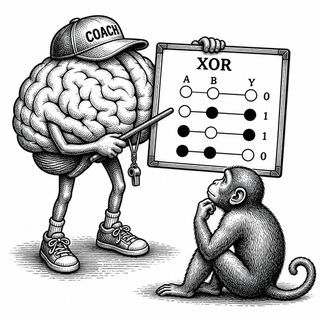
That weird little brain-drill is close to what Wójcik and colleagues tested in macaques. In their new Nature Neuroscience paper, the team recorded from the primate prefrontal cortex while animals learned a brand-new XOR rule from scratch. XOR is logic's fussy bouncer: one setup gets in, another gets rejected, and the answer depends on the combination, not a single feature. Color alone will not save you; neither will shape.
First, Chaos. Then, Jazz Hands.
Early in learning, the monkeys' prefrontal neurons behaved like everyone in a group chat replying at once. Neural activity was high-dimensional, nonlinear, and randomly mixed. Translation: the PFC represented lots of possible features and combinations, because it did not yet know which ones mattered.
This is not bad design. It is exploration. When you do not know the rule, keeping many possibilities alive is useful. Like a gamer entering a new boss fight, the brain is trying every button combo before finding the weak spot.
As training advanced, the geometry changed. The neural code became lower-dimensional and more selective for the rule itself. The PFC stopped carrying every random detail around like an overpacked suitcase and focused on the information needed to solve the task. When the researchers introduced new stimuli that followed the same rule, the code shifted again into a more abstract, stimulus-invariant format. Same play, new uniforms.
What "Neural Geometry" Means Without Requiring a Math Helmet
Neural geometry sounds like something invented to make undergrads reconsider their life choices, but the idea is pretty simple. Imagine every pattern of neural firing as a point in a huge space. Similar thoughts, stimuli, or rules sit closer together. Different ones sit farther apart. The shape of that space tells scientists what the brain is making easy to separate, combine, or generalize.
That framing matters because modern neuroscience has moved beyond asking, "What does this one neuron like?" The better question is often, "What does the whole population make possible?" A 2021 review by Kriegeskorte and Wei explains how tuning and representational geometry connect neural activity to decoding and behavior. In other words, geometry is not decorative math wallpaper. It is the map of what the brain can do next.
The PFC Was Both Messy and Elegant. Rude, But Helpful.
This paper helps settle a long-running argument about the prefrontal cortex. Some studies show PFC activity as messy, high-dimensional, and flexible. Others show compact, rule-like codes. So which is it?
Apparently: yes.
The new results suggest the PFC changes format across learning. Early on, it spreads out information to explore possible rules. Later, it compresses the code to emphasize what matters. That fits with recent work showing that representational geometry in primate PFC can reveal strategy, task structure, and biologically interpretable coding patterns, including studies in Science Advances, Nature Communications, and Neuron.
Look. This is a very brain thing to do. When you are learning a board game, you first track everything: cards, tokens, suspiciously smug friends. After a few rounds, you ignore the decorative nonsense and see the strategy. Your PFC may be doing a cellular version of that, minus the snacks.
Why This Could Matter Outside the Monkey Lab
If these findings hold up and expand, they could reshape how scientists think about flexible learning. Many real-world problems require the same trick: learn a rule in one setting, then apply it somewhere new. Classrooms, therapy, and rehabilitation after brain injury all depend on it. So does every "transfer learning" dream in artificial intelligence, where a system learns something useful instead of memorizing the training set like a panicked student before finals.
The clinical angle is still early. This is not a treatment paper, and nobody should walk away expecting a "geometry booster" pill. But the prefrontal cortex plays a major role in executive control, rule switching, and goal-directed behavior. If scientists can track how healthy brains move from exploration to abstraction, they may get better tools for spotting when that process stalls in neuropsychiatric conditions or after injury.
The best part is the conceptual neatness. Learning does not just fill the brain with facts. It reshapes the space those facts live in. The brain starts with a messy practice field, then paints the lines, trims the roster, and runs the play with new players. Not bad for a wet three-pound prediction machine with terrible cable management.
References
- Wójcik MJ, Stroud JP, Wasmuht D, et al. Learning shapes neural geometry in the primate prefrontal cortex. Nature Neuroscience. 2026. doi:10.1038/s41593-026-02333-w
- Kriegeskorte N, Wei XX. Neural tuning and representational geometry. Nature Reviews Neuroscience. 2021;22:703-718. doi:10.1038/s41583-021-00502-3
- Samborska V, Butler JL, Walton ME, Behrens TEJ, Akam T. Complementary task representations in hippocampus and prefrontal cortex for generalizing the structure of problems. Nature Neuroscience. 2022;25:1314-1326. doi:10.1038/s41593-022-01149-8, PMCID: PMC9534768
- Lin XX, Nieder A, Jacob SN. The neuronal implementation of representational geometry in primate prefrontal cortex. Science Advances. 2023;9:eadh8685. doi:10.1126/sciadv.adh8685, PMCID: PMC10848744
- Fascianelli V, Battista A, Stefanini F, Tsujimoto S, Genovesio A, Fusi S. Neural representational geometries reflect behavioral differences in monkeys and recurrent neural networks. Nature Communications. 2024;15:6479. doi:10.1038/s41467-024-50503-w, PMCID: PMC11294567
- Phillips JM, Afrasiabi M, Kambi NA, et al. Primate thalamic nuclei select abstract rules and shape prefrontal dynamics. Neuron. 2025;113:2014-2027.e12. doi:10.1016/j.neuron.2025.03.021, PMCID: PMC12181055
Disclaimer: The image accompanying this article is for illustrative purposes only and does not depict actual experimental results, data, or biological mechanisms.