
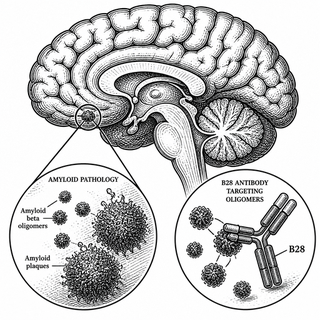
People say the brain is like a computer. It's not. A computer does not grow its own tangled protein lint, summon immune cells to stare angrily at it, and then forget where it put the car keys. The brain is more like a village with electricity, gossip, plumbing, night watchmen, and one extremely dramatic waste-management problem. In Alzheimer's disease, one suspect in that mess is amyloid beta, or Aβ: tiny protein fragments that can clump into plaques, but may do some of their nastiest work earlier as small, soluble oligomers.
The Plaque Is Not the Whole Soap Opera
For years, amyloid plaques got the spotlight because they are big enough to see and scary enough to name. But biology loves a plot twist. The little Aβ oligomers, smaller clumps floating around before or around plaques, may be the real mischief-makers. Think less "abandoned couch on the sidewalk" and more "group chat spreading bad advice at 2 a.m."
That matters because current anti-amyloid antibodies, including lecanemab and donanemab, have finally shown that clearing amyloid can slow decline in early Alzheimer's disease. Not stop it. Not rewind the tape. Slow it. Lecanemab reduced clinical decline modestly over 18 months in the CLARITY AD trial, while donanemab also slowed progression in TRAILBLAZER-ALZ 2, especially in people earlier in the disease course. Both come with real hassles: IV infusions, brain scans, careful patient selection, and the risk of amyloid-related imaging abnormalities, which is the polite medical phrase for "we found swelling or bleeding on MRI and nobody is casually shrugging."
Enter B28, the Antibody With a Filtered Guest List
In the new Cell Reports study, Yang and colleagues built an antibody called B28. The team immunized Trianni mice with aggregated synthetic Aβ, then selected an antibody that could neutralize tau-related neuritic damage caused by oligomers extracted from Alzheimer's brain tissue. That is a very specific audition. B28 was not hired because it waved at all amyloid from across the room. It was chosen because it recognized the sketchier aggregated forms.
Then came the key test: a blinded four-month treatment study in APP NL-G-F knock-in mice, a model engineered to make humanized amyloid pathology without simply overexpressing APP like a biological fog machine. The mice received weekly B28 infusions. Compared with controls, treated mice had fewer amyloid plaques, fewer Aβ oligomers, less plaque-associated astrocytosis and microgliosis, better neuronal preservation, and less memory decline. Microgliosis, by the way, means the brain's immune sentries, microglia, have gone from neighborhood watch to "everyone bring a clipboard."
The lab comparisons were also spicy. In immunoassays, B28 bound Aβ with higher affinity and captured more Aβ from Alzheimer's brain extracts than lecanemab did. That does not mean B28 beats lecanemab in people. It means B28 has an interesting biochemical grip, and scientists have every reason to ask what that grip could do in the clinic.
Why This Could Matter If It Holds Up
The dream here is not just more plaque removal. We already know plaque removal is possible. The better question is whether a next-generation antibody can hit the toxic soluble and plaque-associated Aβ species more effectively, quiet some of the local inflammatory noise, preserve neurons, and translate that into a larger clinical benefit with an acceptable safety profile.
That is a tall order. Mice are useful, but mice also do not misplace tax documents, navigate Medicare coverage, or spend five years slowly losing the thread of a favorite story. Alzheimer's in humans involves amyloid, tau, inflammation, vascular health, genetics, aging, sleep, metabolism, and probably several cellular committees that meet without minutes.
Still, B28 is interesting because it goes after a sharper target. The field has moved from "can we remove amyloid?" to "which amyloid species should we remove, from whom, when, and at what cost?" That is progress. Messy progress, yes. The kind wearing a lab coat with coffee on it. But progress.
If B28 or a relative eventually proves safe and more effective in humans, it could help push Alzheimer's therapy toward earlier, more precise treatment: diagnose the disease biology, identify the dangerous protein assemblies, and intervene before memory circuits have taken too many hits. That would not make Alzheimer's simple. Nothing involving the brain ever stays simple for long. But it might make the village a little less chaotic, and for families living with the disease, even a little less chaos can mean more ordinary days kept intact.
References
- Yang T, Xu YR, Li S, et al. Immunotherapy with B28, an antibody to Aβ oligomers, potently decreases amyloid plaques, microgliosis, and memory decline in APP knock-in mice. Cell Reports. 2026. doi:10.1016/j.celrep.2026.117599
- van Dyck CH, Swanson CJ, Aisen P, et al. Lecanemab in early Alzheimer's disease. New England Journal of Medicine. 2023. doi:10.1056/NEJMoa2212948
- Sims JR, Zimmer JA, Evans CD, et al. Donanemab in early symptomatic Alzheimer disease: The TRAILBLAZER-ALZ 2 randomized clinical trial. JAMA. 2023. doi:10.1001/jama.2023.13239, PMCID: PMC10352931
- Self WK, Holtzman DM. Emerging diagnostics and therapeutics for Alzheimer disease. Nature Medicine. 2023. doi:10.1038/s41591-023-02505-2
- An J, Kim K, Lim HJ, et al. Early onset diagnosis in Alzheimer's disease patients via amyloid-β oligomers-sensing probe in cerebrospinal fluid. Nature Communications. 2024. doi:10.1038/s41467-024-44818-x, PMCID: PMC10837422
- Knopman DS, Amieva H, Petersen RC, et al. Alzheimer disease. Nature Reviews Disease Primers. 2021. doi:10.1038/s41572-021-00269-y, PMCID: PMC8574196
Disclaimer: The image accompanying this article is for illustrative purposes only and does not depict actual experimental results, data, or biological mechanisms.