
The road to treating brain disease has never been a highway. It has been more like a strange medical road trip: wrong exits, dead-end towns, and then a sign that says "direct brain access, next right." Brain-computer interfaces, or BCIs, are that turnoff. They promise detours around broken nerves, frozen muscles, lost speech, and misfiring circuits. Casual stuff. Bring snacks.
The Shortcut Around the Broken Road
A BCI reads brain activity and uses it to control something outside the brain: a cursor, a robotic arm, a stimulator, a speech decoder, maybe one day a wheelchair that does not interpret "left" as "decorative crash into table."
Feng and colleagues describe a mash-up of neuroscience, materials science, surgery, machine learning, rehabilitation, and patience. Their 2026 review in Exploration maps how BCIs are moving into disease treatment, especially for movement disorders, communication barriers, and psychiatric conditions (DOI, PMCID).
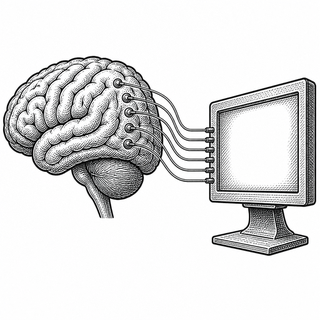
The big idea is simple: if the body cannot carry the message, let the brain send it another way. It is neurological rerouting. Like Waze, but for motor cortex.
Speech, but From the Wiring
Some of the most vivid progress is in communication. People with paralysis or ALS may know exactly what they want to say while their muscles refuse to cooperate. The brain writes the memo. The body leaves it in drafts.
Recent speech neuroprostheses now decode intended speech from neural activity. In 2023, a Nature study used cortical signals to drive text and an animated avatar for a person with severe paralysis (DOI, PMCID). In 2024, a New England Journal of Medicine team reported a speech neuroprosthesis that calibrated quickly and decoded attempted speech with high accuracy (DOI, PMCID).
This is not "mind reading" in the comic-book sense. Nobody is extracting your secret opinion about your neighbor's wind chimes. These systems usually need implanted sensors, training, and deliberate attempts to speak. Still, the direction is powerful: speech may become less dependent on the mouth.
Movement Gets a Second Channel
BCIs also aim to restore action. A person might control a cursor, a prosthetic arm, or electrical stimulation that activates muscles. The system listens to motor cortex, then converts patterns into movement commands.
That sounds tidy. It is not. Brain signals drift. Electrodes age. Scar tissue acts like a petty landlord. Algorithms must adapt while the person adapts too. The brain is not a USB port, no matter how badly engineers want it to behave.
Still, the field is finding less invasive paths. The Stentrode, an endovascular BCI placed through blood vessels rather than open brain surgery, showed safety and digital-switch control in four people with severe paralysis (DOI, PMCID). The best implant is often the one people can receive without turning neurosurgery into a season finale.
When the Implant Listens Back
The next step is responding.
Closed-loop systems detect a brain state and deliver stimulation when needed. For Parkinson's disease, adaptive deep brain stimulation may tune therapy to symptoms instead of blasting the same signal all day like a neighbor with one playlist. In psychiatry, researchers are testing whether neural biomarkers can guide personalized stimulation.
One early example came from treatment-resistant depression: a Nature Medicine case report used closed-loop neuromodulation to detect a patient-specific neural pattern and stimulate a targeted circuit (DOI, PMCID). A 2024 Nature Reviews Bioengineering review argues that this BCI-style approach could help psychiatry move from broad symptom categories toward circuit-level care (DOI, PMCID).
That is the dream: not "depression, apply electricity," but "this person's network is entering a bad state, intervene precisely." Less sledgehammer. More locksmith.
The Wires Are Still the Plot
Feng's review spends real time on materials because electrodes are the whole game. They must record tiny signals, survive wet salty tissue, avoid inflammation, and keep working for years. A brain implant has one job: be useful without becoming the problem. Many printers fail under easier conditions.
Researchers are testing carbon nanomaterials, flexible composites, optogenetics, multimodal sensing, and AI-driven decoding. If these advances hold up, BCIs could become more stable, more personal, and less exhausting to use.
The catch is scale. Many successes still involve small numbers of participants, expert teams, and controlled settings. Reproducibility will decide whether BCIs become routine care or remain dazzling prototypes that make excellent conference slides.
A New Era, Pending Batteries
The Feng review is optimistic, but not silly. BCIs could help people move, speak, regulate symptoms, and regain daily agency. That is not science fiction. It is engineering with a long invoice.
The future may look less like a cyborg movie and more like a patient sending a text, adjusting stimulation, or controlling a device without needing a muscle to cooperate. Quiet progress. Huge consequences. The brain may finally get a better set of adapters.
References
Feng Y, Zhang W, Chen J, et al. Brain-Computer Interfaces: The Dawn of a New Era in Disease Treatment. Exploration (Beijing). 2026;6(3):20250452. doi:10.1002/EXP.20250452. PMCID: PMC13317701.
Oganesian LL, Shanechi MM. Brain-computer interfaces for neuropsychiatric disorders. Nature Reviews Bioengineering. 2024;2(8):653-670. doi:10.1038/s44222-024-00177-2. PMCID: PMC12453833.
Card NS, Wairagkar M, Iacobacci C, et al. An Accurate and Rapidly Calibrating Speech Neuroprosthesis. New England Journal of Medicine. 2024;391(7):609-618. doi:10.1056/NEJMoa2314132. PMCID: PMC11328962.
Metzger SL, Littlejohn KT, Silva AB, et al. A high-performance neuroprosthesis for speech decoding and avatar control. Nature. 2023;620(7976):1037-1046. doi:10.1038/s41586-023-06443-4. PMCID: PMC10826467.
Mitchell P, Lee SCM, Yoo PE, et al. Assessment of Safety of a Fully Implanted Endovascular Brain-Computer Interface for Severe Paralysis in 4 Patients: The Stentrode With Thought-Controlled Digital Switch (SWITCH) Study. JAMA Neurology. 2023;80(3):270-278. doi:10.1001/jamaneurol.2022.4847. PMCID: PMC9857731.
Scangos KW, Khambhati AN, Daly PM, et al. Closed-loop neuromodulation in an individual with treatment-resistant depression. Nature Medicine. 2021;27(10):1696-1700. doi:10.1038/s41591-021-01480-w. PMCID: PMC11219029.
Disclaimer: The image accompanying this article is for illustrative purposes only and does not depict actual experimental results, data, or biological mechanisms.