
Good news: some nerve-injury pain can calm down on its own. Bad news: when researchers watched that cleanup happen in mouse dorsal root ganglia, male and female biology used different playbooks, as if pain recovery had separate group chats and nobody shared the pinned document.
Meet the DRG, Pain's Complaint Desk
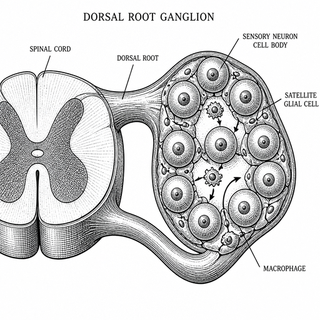
The dorsal root ganglion, or DRG, is a cluster of sensory neuron cell bodies near the spinal cord. It is not glamorous. It is more like the nervous system's complaint desk, where every "hot stove," "weird tingle," and "why does my sock feel like sandpaper?" report gets routed.
Neuropathic pain happens when nerves get damaged or diseased. Instead of acting like a useful alarm, the system becomes a smoke detector that screams every time you make toast. Treatments help some people, but many get only partial relief, which is science-speak for "still very annoying."
The Study: 7,495 Tiny Crime Scenes
In the new Cell Reports paper, Schlott and colleagues studied mice after traumatic nerve injury and during natural pain resolution. They analyzed 7,495 DRG images and 62 transcriptomes, the kind of dataset that makes a spreadsheet quietly ask for hazard pay (Schlott et al., 2026).
They focused on three characters: sensory neurons, satellite glial cells, and macrophages. Sensory neurons carry the signal. Satellite glial cells wrap around neuron bodies like anxious stage managers. Macrophages clean up messes, signal danger, or sometimes "help" by moving all your kitchen drawers around.
The initial injury response looked broadly shared. The sex split appeared later, during pain resolution.
Pain Leaving Is Not Just Pain Stopping
Pain resolution did not look like the tissue simply lost neurons or shrank away from the problem. The animals recovered without DRG tissue loss or sensory neuron loss. That suggests recovery can involve active cellular remodeling, not a scorched-earth shutdown.
After injury, macrophages moved into the space between sensory neurons and their satellite glial companions. During resolution, that arrangement partly reversed, especially in males. In females, immune-related gene expression and macrophage phenotypes lingered longer. In males, satellite glial activation and neuron-glia contact stayed more persistent.
So yes, both sexes reached a calmer pain state, but they seemed to take different backstage routes. Same theater exit, different hallway. The nervous system has a brand to maintain.
Why This Could Matter
A lot of pain research asks how pain starts and sticks around. This study asks a better question: how does pain leave? Blocking pain signals helps, but teaching the system to resolve pain is the dream. Less "mute the alarm," more "please stop burning toast."
The sex-specific part also matters because human pain biology is not one-size-fits-all. Human DRG studies have found sex differences in neuropathic pain genes (Ray et al., 2023). Reviews keep circling the same awkward truth: glia and immune cells are not background extras. They are in the writers' room (Berta et al., 2026).
If this work holds up in humans, it could help researchers find biomarkers for who is likely to recover, who may develop persistent pain, and which cells deserve attention. Female-biased immune persistence might call for one strategy. Male-biased neuron-glia contact might call for another. Precision pain medicine stops sounding like a buzzword when the cells are running different scripts.
The Caution Label, Because Biology Enjoys Humbling Us
This was mouse work, not a clinic-ready treatment. Mouse DRGs are not tiny human DRGs wearing lab coats. Pain in people can involve diabetes, chemotherapy, shingles, surgery, stress, sleep, and the curse of "I bent down normally and now my spine has opinions."
Still, the paper adds a useful idea: pain recovery may have its own biology, and that biology may depend on sex. For patients stuck in medication roulette, that is more than trivia. It is a map of where to look next.
References
- Schlott F, Hartmannsberger B, Bischler T, et al. Sex-specific molecular and cellular phenotypes during resolution of neuropathic pain in dorsal root ganglia. Cell Rep. 2026;45(6):117442. doi:10.1016/j.celrep.2026.117442
- Berta T, Khoutorsky A, Xu J, Ji RR. Glial cells in neuropathic pain. Physiol Rev. 2026;106(4):2079-2148. doi:10.1152/physrev.00034.2025. PMCID: PMC13276489
- Ray PR, Shiers S, Caruso JP, et al. RNA profiling of human dorsal root ganglia reveals sex differences in mechanisms promoting neuropathic pain. Brain. 2023;146(2):749-766. doi:10.1093/brain/awac266. PMCID: PMC10169414
- Soliman N, Moisset X, Ferraro MC, et al. Pharmacotherapy and non-invasive neuromodulation for neuropathic pain: a systematic review and meta-analysis. Lancet Neurol. 2025;24(5):413-428. doi:10.1016/S1474-4422(25)00068-7
- Hartmannsberger B, Ben-Kraiem A, Kramer S, et al. TAM receptors mediate the Fpr2-driven pain resolution and fibrinolysis after nerve injury. Acta Neuropathol. 2024;149(1):1. doi:10.1007/s00401-024-02840-9. PMCID: PMC11649718
Disclaimer: The image accompanying this article is for illustrative purposes only and does not depict actual experimental results, data, or biological mechanisms.