
Every night, your brain revises its threat paperwork without telling you. Most of the time, this is useful. You want the alarm system to remember that hot stoves are bad, speeding cars are worse, and group texts after midnight are a trap. But after trauma, the system can keep stamping "ACTIVE COMBAT ZONE" on ordinary life. A door slam becomes incoming fire. The amygdala, that tiny command bunker of fear, starts acting like it has a clipboard and no supervisor.
That is the territory mapped by Li and colleagues in a Biological Psychiatry study of DNA methylation in PTSD brain [1]. The team was not looking for a single "PTSD gene," because biology is rarely that polite. They examined 1,065,750 DNA methylation sites from 171 donors across six fear-circuit regions, comparing controls with PTSD and major depressive disorder (MDD) cases.
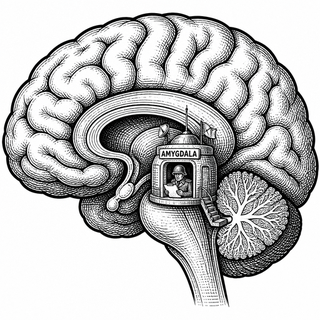
The Genome Gets Sticky Notes
DNA methylation is one of the body's quieter control systems. It does not rewrite your genetic code. It adds small chemical tags that can tune gene activity. Think of the genome as the military manual and methylation as the field annotations: "use this more," "silence this," "bad idea near the hippocampus."
PTSD is not just a memory problem. It is a threat-learning problem, a body-alert problem, a sleep problem, an immune problem, and, frankly, a logistics problem. The amygdala, hippocampus, and related regions have to decide what is dangerous, what is past, and what belongs in today's weather report. In PTSD, those supply lines can get confused.
Li's group found PTSD-linked methylation differences near 195 genes. Then they matched those chemical marks with RNA sequencing, asking whether methylation changes lined up with gene expression. A methylation map alone can say, "something happened here." Pairing it with RNA can suggest, "and this may have changed the orders being sent."
Who Was Holding the Radio?
The study also built a cell-type-specific methylation atlas using single-nucleus RNA sequencing references. Translation: the team tried to figure out which kinds of brain cells were carrying which epigenetic signals. That is a big upgrade from treating brain tissue like soup and then acting shocked when the soup has opinions.
Recent work has been pushing the same direction. A 2025 Nature study profiled PTSD brain tissue at single-cell resolution and found changes involving inhibitory neurons, endothelial cells, microglia, stress-hormone signaling, GABA transmission, and neuroinflammation [2]. In plain English: the cells that quiet the room, guard the blood-brain border, and manage immune cleanup may all be in the report.
The new study adds another layer: not just which genes are active, but which switches may keep them active or silent.
The Ketamine Clue, With a Helmet On
One intriguing flank involves ketamine, a drug already being studied for depression and PTSD symptoms. The researchers linked blood DNA methylation biomarkers from a human PTSD ketamine trial to brain methylation patterns, highlighting MAD1L1, ELFN1, and WNT5A in ketamine responders [1].
Do not sprint to the pharmacy waving a methylation chart. This is not a treatment recipe. It is more like finding three sets of bootprints near the perimeter fence. Useful? Yes. Case closed? Absolutely not, detective.
Still, the clue fits a broader push. A 2025 pilot study reported DNA methylation and epigenetic aging biomarker changes after ketamine treatment in people with MDD and PTSD [3]. That does not prove ketamine rewires trauma at the DNA-tag level, but it gives researchers coordinates. Coordinates beat vibes.
Why This Map Matters
One problem in PTSD biology is that blood is easy to sample, but the brain is where the siege is happening. Another problem: PTSD overlaps with depression, anxiety, substance use, and chronic stress, so molecular signals can blur like a bad photocopy of a secret memo.
This study tries to address both. It used actual brain tissue across fear-related regions and included an MDD comparison group without known trauma or PTSD. That helps separate PTSD biology from depression biology, at least partly. A large 2024 Genome Medicine meta-analysis also found PTSD-associated methylation sites across 23 military and civilian cohorts, showing that the signal is not just one lab's pet spreadsheet wearing a lab coat [4].
If these findings replicate and expand, they could help researchers identify PTSD subtypes, track treatment response, and design therapies aimed at specific cell pathways instead of carpet-bombing symptoms. Not magic. Not a cure-by-Thursday situation. More like finally getting a decent map after years of marching through fog while the amygdala yells, "I know a shortcut."
PTSD is often described as the past refusing to stay past. This paper suggests part of that refusal may be written in chemical marks across the brain's fear circuitry. The ink is not destiny. But it may show where the next campaign should begin.
References
-
Li H, Liu Y, Shi Y, Wang J, Nguyen TP, et al. Mapping DNA Methylation Signatures to Identify Epigenetic Variation Across Subcortical Regions of the Human Posttraumatic Stress Disorder Brain. Biological Psychiatry. 2026;100(1):76-87. DOI: https://doi.org/10.1016/j.biopsych.2025.10.032. PMID: 41192574. PMCID: PMC12862789.
-
Hwang A, Skarica M, Xu S, Coudriet J, Lee CY, et al. Single-cell transcriptomic and chromatin dynamics of the human brain in PTSD. Nature. 2025;643(8072):744-754. DOI: https://doi.org/10.1038/s41586-025-09083-y. PMID: 40533550. PMCID: PMC12267058.
-
Dawson KL, Carangan AMJM, Klunder J, Carreras-Gallo N, Sehgal R, et al. Epigenetic aging and DNA methylation biomarker changes following ketamine treatment in patients with MDD and PTSD: a pilot study. Translational Psychiatry. 2025;15:452. DOI: https://doi.org/10.1038/s41398-025-03683-y. PMID: 41173838. PMCID: PMC12579232.
-
Katrinli S, Wani AH, Maihofer AX, Ratanatharathorn A, Daskalakis NP, et al. Epigenome-wide association studies identify novel DNA methylation sites associated with PTSD: a meta-analysis of 23 military and civilian cohorts. Genome Medicine. 2024;16:147. DOI: https://doi.org/10.1186/s13073-024-01417-1. PMID: 39696436. PMCID: PMC11658418.
-
Al Jowf GI, Snijders C, Rutten BPF, de Nijs L, Eijssen LMT. The Molecular Biology of Susceptibility to Post-Traumatic Stress Disorder: Highlights of Epigenetics and Epigenomics. International Journal of Molecular Sciences. 2021;22(19):10743. DOI: https://doi.org/10.3390/ijms221910743. PMID: 34639084. PMCID: PMC8509551.
Disclaimer: The image accompanying this article is for illustrative purposes only and does not depict actual experimental results, data, or biological mechanisms.