
A scraped knee was once a whole domestic production: one heroic plaster, then the strange thrill of watching the scab do its quiet work. The central nervous system, alas, is less obliging. Injure the spinal cord and the clean-up crew arrives, but the repair job is slower, more political, and full of cells behaving like a council meeting with calcium signals.
That is why a new Cell Reports study is worth a raised eyebrow. Cao and colleagues studied mouse spinal cord injury and found that astrocytes and microglia coordinate repair through a two-way chemical conversation: astrocytes send CSF1, and microglia answer with IFN-beta Cao et al., 2026. Less "one cell saves the day," more "the group chat finally became useful," a rare event in biology and indeed society.
Meet the Glial Neighbours
Neurons get the glamour. They fire signals, make memories, and swan about like tiny celebrities. Glia do the less photogenic work: feeding neurons, shaping synapses, watching for trouble, and responding to damage.
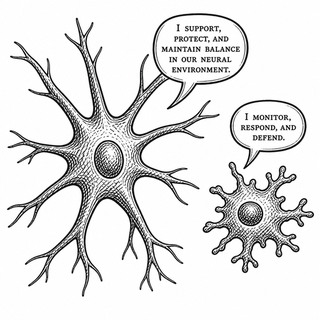
Astrocytes are star-shaped support cells that maintain the chemical neighbourhood. After injury, they can form a border around damaged tissue. This "glial scar" has had a public relations problem for decades. It can block regrowing nerve fibres, yes. It can also wall off damage and help restore order. Biology enjoys moral ambiguity. Very Victorian.
Microglia are the resident immune cells of the brain and spinal cord. They patrol, prune, clear debris, and can repair or fan inflammatory flames depending on timing. Recent work shows that microglia coordinate repair after spinal cord injury Brennan et al., 2022. Single-cell studies reveal how many cell states appear after injury, because apparently a damaged spinal cord is not content with being merely damaged Milich et al., 2021.
The Molecular Ping-Pong Match
The researchers used a focal spinal cord injury in mice. At the lesion border, reactive astrocytes increased colony-stimulating factor 1, or CSF1. CSF1 is a growth and survival signal for microglia. When the team removed CSF1 specifically from astrocytes, microglia did not proliferate properly near the wound.
That alone would be tidy enough. But the nervous system dislikes tidy stories. Removing astrocyte CSF1 also reduced border-forming astrocytes. The cell that sent the message depended on the reply. Somewhere, a systems biologist reached for stronger coffee.
The reply involved interferon-beta, or IFN-beta. Interferons usually mean antiviral defence, the immune system shouting "lock the doors." Here, microglia produced IFN-beta, and astrocytes needed interferon signalling to survive and form a proper injury border. Disrupt that signalling in astrocytes, and wound closure and motor recovery worsen.
So the loop looks like this: injured-border astrocytes produce CSF1, CSF1 supports microglial proliferation, microglia produce IFN-beta, and IFN-beta helps astrocytes survive and build the border. Not a solo performance. More a competent committee, which is still better than most committees.
Why This Changes the Repair Story
Spinal cord injury research has long wrestled with a nasty puzzle: inflammation can harm tissue, but suppressing it too bluntly can also remove repair signals. Likewise, scarring can limit axon growth, but removing scar-forming astrocytes can make injury worse. The trick is knowing which conversation cells are having, when, and whether they are speaking sense or just cellular nonsense in a waistcoat.
This study sharpens that problem. Astrocyte-microglia crosstalk is not background noise. It can shape wound closure and recovery. A 2026 Nature study found that distant astrocytes can guide microglia-mediated white matter repair McCallum et al., 2026. A 2025 PNAS paper showed that astrocytic Ryk signalling helps coordinate scarring and wound healing Shen et al., 2025. The theme is hard to miss: glia are not wallpaper. They are running logistics.
The Human-Sized Caveat
Before anyone prints "IFN-beta fixes spinal cords" on a mug, this was mouse work. Mouse spinal cord injuries are controlled models, not the human reality of trauma, varied severity, infection risk, rehabilitation, and the thousand unglamorous details that decide outcomes. Immune signals are also context-dependent. Give the right signal at the wrong time and you may get biology's equivalent of rearranging furniture during a fire.
Still, the study offers a useful therapeutic idea: future treatments may need to tune repair conversations rather than simply blocking inflammation or dissolving scars. If researchers learn when astrocytes should speak CSF1, when microglia should answer with IFN-beta, and how to avoid overcooking the response, spinal cord repair might become less demolition site and more managed rebuild.
The old cartoon version of the injured nervous system had neurons as tragic heroes and glia as scenery. This paper gives us a better cast list. The support cells have lines. Some of them are rather good.
References
- Cao T, Hemati-Gourabi M, Liu Y, Mills AE, Baur L, Rice EP, Klippel T, Yan Y, Xu X, Fenske WK, Jiang JX, Chen M. Astrocyte-microglia crosstalk via CSF1 and IFN-beta promotes central nervous system repair. Cell Reports. 2026;45(6):117418. PMID: 42217185. DOI: 10.1016/j.celrep.2026.117418.
- Brennan FH, Li Y, Wang C, Ma A, Guo Q, Li Y, Pukos N, Campbell WA, Witcher KG, Guan Z, Kigerl KA, Hall JCE, Godbout JP, Fischer AJ, McTigue DM, He Z, Ma Q, Popovich PG. Microglia coordinate cellular interactions during spinal cord repair in mice. Nature Communications. 2022;13:4096. PMID: 35835751. PMCID: PMC9283484. DOI: 10.1038/s41467-022-31797-0.
- Milich LM, Choi JS, Ryan C, Cerqueira SR, Benavides S, Yahn SL, Tsoulfas P, Lee JK. Single-cell analysis of the cellular heterogeneity and interactions in the injured mouse spinal cord. Journal of Experimental Medicine. 2021;218(8):e20210040. PMID: 34132743. PMCID: PMC8212781. DOI: 10.1084/jem.20210040.
- McCallum S, Suresh KB, Islam TS, Tripathi MK, Saustad AW, Shelest O, Patil A, Lee D, Kwon B, Leitholf K, Yenokian I, Shaka SE, Beveridge CH, Manchandra P, Randolph CE, Meares GP, Dutta R, Plummer J, Calsavara VF, Kawaguchi R, Knott SRV, Chopra G, Burda JE. Lesion-remote astrocytes govern microglia-mediated white matter repair. Nature. 2026;649:959-970. PMID: 41407858. PMCID: PMC12823418. DOI: 10.1038/s41586-025-09887-y.
- Shen Z, Feng B, Lim WL, Woo T, Liu Y, Vicenzi S, Wang J, Kwon BK, Zou Y. Astrocytic Ryk signaling coordinates scarring and wound healing after spinal cord injury. Proceedings of the National Academy of Sciences of the United States of America. 2025;122(15):e2417400122. PMID: 40208942. PMCID: PMC12012454. DOI: 10.1073/pnas.2417400122.
Disclaimer: The image accompanying this article is for illustrative purposes only and does not depict actual experimental results, data, or biological mechanisms.