
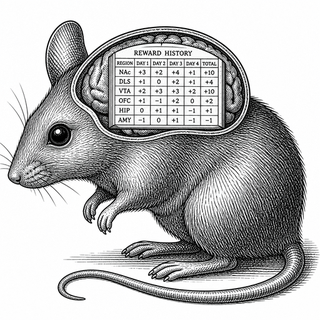
I'll confess: this topic is hard to write about because "GABAergic neurons encode reward history" sounds like somebody hid a spreadsheet inside a mouse brain. Worth it, though, because the brain may be doing something very game-like here: tracking recent wins and losses, then deciding whether to keep grinding the same level or go loot the suspicious cave.
Reward research usually gives the spotlight to excitatory neurons. They shout "go!" with glutamate, the brain's biochemical group chat. GABAergic neurons often get cast as the bouncers: inhibit, restrain, keep the neural nightclub from becoming a fire-code incident.
But in a new Cell Reports paper, Iyer and colleagues recorded GABAergic neurons in two reward-relevant regions - medial prefrontal cortex (mPFC) and ventral hippocampus (vHip) - while male mice made reward-guided choices. Plot twist: the bouncers were also keeping the scorebook [1].
Tiny Mice, Big Spreadsheet Energy
The key idea is reward history. Not just "did I get the treat?" but "how has this strategy been paying lately?" A decent game teaches this constantly. If one hallway drops coins and another gives you emotional damage in a cape, you update the plan. The mouse brain does too, minus the minimap and dignity-preserving pause menu.
The mPFC helps with flexible behavior, rules, and "maybe stop pressing the button that keeps betraying you." The vHip brings context and memory to decisions. Previous work showed that excitatory inputs from mPFC and vHip to the nucleus accumbens can integrate recent rewards and tune task engagement [2]. This study asks whether inhibitory cells also carry that kind of information.
They did.
The Quiet Cells Were Keeping Score
GABAergic neurons in both mPFC and vHip showed a shared pattern: relative suppression of activity tracked outcome history. In plain English, their activity shifted with the animal's recent reward streak.
That matters because inhibition often gets described as a brake pedal. Useful, yes. Glamorous, no. But a brake pedal can tell you a lot about the driver. Are they cruising? Panicking? Believing in themselves directly into a wall? Context matters.
Here, the context was behavioral state. The authors split behavior into exploration and exploitation. Exploration means sampling options to learn. Exploitation means leaning into what already works. Every player knows the dilemma: farm the reliable loot spot, or check the cave labeled "absolutely not a boss fight."
The reward-history signal depended on that mode. Exploration gated outcome-history encoding in both mPFC and vHip GABAergic neurons. So these cells were not broadcasting one boring universal "reward happened" message. Their coding changed with what the animal was trying to do.
Engagement Is the Real Boss Fight
The researchers also found that GABAergic activity in both regions predicted task engagement. That is where the finding starts to matter beyond the mouse lever-press economy.
Reward processing goes sideways in depression, addiction, compulsive behavior, and problems with motivation or flexibility. This paper does not hand us a therapy sword. It studied male mice, and mouse-to-human translation is a long side quest with too many locked doors.
Still, the concept is useful. If inhibitory neurons help track recent outcomes and behavioral state, then reward models focused mostly on excitatory cells are missing a major character. Modern circuit work already shows that reward behavior depends on loops linking prefrontal cortex, hippocampus, nucleus accumbens, dopamine systems, and local inhibition [2-5]. This paper adds: do not leave the inhibitory cells in the NPC pile.
Why This Is Actually Cool
State sensitivity is the fun part. A missed reward during exploration might mean "keep sampling." A missed reward during exploitation might mean "buddy, your build is cooked." Same outcome, different meaning.
If future studies reproduce and expand these findings, especially in females, other tasks, and defined interneuron subtypes, they could sharpen how we think about motivation and flexibility. They may help explain why some brains get stuck exploiting bad strategies, while others explore chaotically like someone mashed every controller button at once.
For now, the takeaway is simple: inhibitory neurons are not just the brain's mute button. In these male mice, mPFC and ventral hippocampal GABAergic neurons helped encode the recent reward scoreboard, and they did it differently depending on whether the animal was scouting the map or farming XP.
The support class was secretly tracking the whole campaign. Classic.
References
-
Iyer ES, Cvetkovska V, Lopez J, Ebitz RB, Bagot RC. GABAergic neurons in medial prefrontal cortex and ventral hippocampus encode information about reward history in male mice. Cell Reports. 2026;45(7):117617. https://doi.org/10.1016/j.celrep.2026.117617
-
Iyer ES, Vitaro P, Wu S, et al. Reward integration in prefrontal-cortical and ventral-hippocampal nucleus accumbens inputs cooperatively modulates engagement. Nature Communications. 2025;16:3573. PMCID: PMC12000462. https://doi.org/10.1038/s41467-025-58858-4
-
Topolnik L, Tamboli S. The role of inhibitory circuits in hippocampal memory processing. Nature Reviews Neuroscience. 2022;23(8):476-492. https://doi.org/10.1038/s41583-022-00599-0
-
Tzilivaki A, Tukker JJ, Maier N, Poirazi P, Sammons RP, Schmitz D. Hippocampal GABAergic interneurons and memory. Neuron. 2023;111(20):3154-3175. PMCID: PMC10593603. https://doi.org/10.1016/j.neuron.2023.06.016
-
Muir J, Iyer ES, Tse YC, et al. Sex-biased neural encoding of threat discrimination in nucleus accumbens afferents drives suppression of reward behavior. Nature Neuroscience. 2024;27(10):1966-1976. https://doi.org/10.1038/s41593-024-01748-7
Disclaimer: The image accompanying this article is for illustrative purposes only and does not depict actual experimental results, data, or biological mechanisms.