
Confession: perineuronal nets are hard to write about because the name sounds like a bargain-bin sci-fi fishing tool, and the biology is somehow even weirder. But they may help explain how your brain loads a mental map without corrupting the whole save file, so yes, we are absolutely going in.
The Sticky Armor Around the Speedrunners
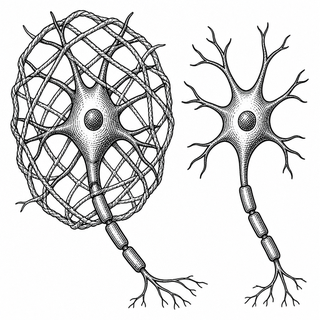
Perineuronal nets, or PNNs, are specialized scaffolds in the brain's extracellular matrix. Translation: they are molecular mesh jackets wrapped around certain neurons, especially parvalbumin interneurons, the fast inhibitory cells that keep local circuits from turning into an electrical food fight. These nets help stabilize synapses and limit plasticity, which sounds boring until you realize "too much plasticity" is basically your brain letting every app edit the operating system.
Reviews over the past few years have pushed PNNs from "structural wallpaper" to serious memory machinery. They help tune when circuits stay flexible and when they lock things down for reliable use later (Fawcett et al., 2022).
Meet the Retrosplenial Minimap
The new paper focuses on the retrosplenial cortex, or RSC, a region tucked along the medial cortex that behaves like the brain's navigation UI. The hippocampus is famous for maps, place cells, and "where did I park?" drama. The RSC helps connect that spatial memory system with broader cortical networks, turning internal maps into usable route guidance.
If the hippocampus is your open-world map, the RSC is the minimap plus quest marker plus that one NPC who knows where the cave entrance is. Recent work has made the RSC look less like one blob and more like a set of specialized circuits for spatial cognition and action planning (Alexander et al., 2023; Lin et al., 2025).
The Experiment: Remove the Net, Break the Party Chat
Hawthorn and colleagues asked a clean question: what happens if you degrade PNNs in the granular retrosplenial cortex of mice and then ask the animals to recall a spatial memory?
The answer was not "congratulations, extra plasticity unlocked." The mice showed impaired spatial memory recall. Meanwhile, the RSC got noisier by one common activity marker: more c-Fos-positive cells. In brain terms, that is less like a well-coordinated raid team and more like everyone mashing buttons because the boss music started.
The electrical recordings made the story sharper. In the RSC, gamma oscillations dropped. Theta-gamma coupling weakened. In dorsal CA1, a hippocampal subregion tied to spatial memory, theta oscillations also fell off. Most telling, gamma coupling between hippocampus and RSC declined, and the functional connectivity between excitatory spike pairs in the two regions weakened (Hawthorn et al., 2026).
That matters because memory recall is not just opening a file. It is more like loading a save state from distributed servers while the network is under load and someone installed three cursed mods. The hippocampus and cortex have to coordinate timing, routing, and signal strength. PNNs may help keep that communication stable enough for recall to work.
Why the Nets Are Not Just Bubble Wrap
The tempting story is "PNNs block plasticity, so remove them and learning gets better." Sometimes, sure. In some contexts, loosening extracellular matrix constraints can reopen plasticity windows or change learning. But biology loves DLC nobody asked for.
A 2023 PNAS study showed that specific sugar chemistry on hippocampal PNNs regulates social memory, meaning the details of the net matter, not just whether it exists (Huang et al., 2023). Other recent work has shown that hippocampal-retrosplenial communication is an active, structured channel, not just a vague "brain regions talk" hand wave (Gonzalez et al., 2026).
So the cool idea here is not "PNNs store memories by themselves." It is that PNNs may stabilize the rhythm section of memory recall. They keep key inhibitory neurons tuned, which keeps gamma timing and hippocampal-cortical coupling from going full garage band.
The Real-World Version, Minus the Cheat Codes
If this finding holds up and expands across ages, sexes, tasks, and species, it could matter for disorders where memory retrieval and navigation degrade, including aging-related cognitive decline and Alzheimer's disease. The RSC is already interesting in navigation and memory problems, and PNNs keep showing up in conversations about plasticity, protection, and disease.
But nobody should read this as "dissolve brain nets, become a memory wizard." The study used targeted experimental manipulation in mice, not a human treatment. Also, stability is not the enemy. A brain with zero brakes is not enlightened - it is a physics engine glitching through the floor.
The better takeaway is subtler and more useful: memory recall may depend on molecular structures that help distant brain regions stay in sync. The brain's map system does not just need good neurons. It needs good timing, good wiring, and apparently good cable management.
References
Hawthorn P, Xiao D, Sullivan RKP, Burne THJ, Balbi M. Retrosplenial perineuronal nets support hippocampal-cortical coupling and spatial memory recall. Cell Reports. 2026;45(6):117440. doi:10.1016/j.celrep.2026.117440
Fawcett JW, Fyhn M, Jendelova P, Kwok JCF, Ruzicka J, Sorg BA. The extracellular matrix and perineuronal nets in memory. Molecular Psychiatry. 2022;27:3192-3203. doi:10.1038/s41380-022-01634-3; PMCID: PMC9708575
Alexander AS, Place R, Starrett MJ, Chrastil ER, Nitz DA. Rethinking retrosplenial cortex: Perspectives and predictions. Neuron. 2023;111(2):150-175. doi:10.1016/j.neuron.2022.11.006; PMCID: PMC11709228
Huang H, Joffrin AM, Zhao Y, Miller GM, Zhang GC, Oka Y, Hsieh-Wilson LC. Chondroitin 4-O-sulfation regulates hippocampal perineuronal nets and social memory. PNAS. 2023;120(24):e2301312120. doi:10.1073/pnas.2301312120; PMCID: PMC10268298
Lin X, Ghafuri A, Chen X, Kazmi M, Nitz DA, Xu X. Projection-specific circuits of retrosplenial cortex with differential contributions to spatial cognition. Molecular Psychiatry. 2025;30:2068-2084. doi:10.1038/s41380-024-02819-8; PMCID: PMC12014379
Gonzalez J, Voroslakos M, Aykan D, Soto N, Nitzan N, Swanson R, Karadas M, Chen ZS, Buzsaki G. Subspace communication in the hippocampal-retrosplenial axis. Nature. 2026;655:192-201. doi:10.1038/s41586-026-10481-z; PMCID: PMC13317024
Disclaimer: The image accompanying this article is for illustrative purposes only and does not depict actual experimental results, data, or biological mechanisms.