
Santiago Ramon y Cajal famously called neurons "the mysterious butterflies of the soul," which is lovely until you remember that even butterflies need garbage collection. In the rainy weather of cellular stress, cells stop their usual bustle, tuck away vulnerable RNA messages, and gather proteins into emergency shelters called stress granules. Beautiful? Yes. Tidy? Only if someone remembers to take the tents down.
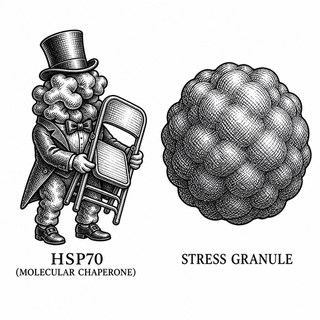
When The Cell Pulls The Fire Alarm
Stress granules are not random clumps. They are temporary, membrane-free blobs made mostly of RNA and proteins, like pop-up storm shelters in the cytoplasm. The cell pauses some protein-making, parks selected messages, waits for the skies to clear, and then ideally dissolves the whole thing.
That "ideally" is doing a suspicious amount of work.
In amyotrophic lateral sclerosis (ALS), proteins linked to disease, including FUS and TDP-43, can drift into stress-granule biology. ALS destroys motor neurons, gradually stealing movement, speech, swallowing, and breathing. So scientists keep asking: are stress granules protecting cells, or are they where good intentions become a protein traffic jam?
The answer, because biology enjoys making us earn our coffee, appears to be: both. A 2024 study found that reducing stress-granule formation worsened several neurodegeneration models, suggesting granules can buffer cells from harm (Glineburg et al., 2024). But a 2025 Cell paper showed that TDP-43 can "demix" inside stress granules and form pathological aggregates, like one guest at a party building a private fortress in the kitchen (Yan et al., 2025).
Enter The Protein Bouncers
The new Cell Reports study by Mastromarco and colleagues focuses on the cleanup crew: HSP70 and J-domain proteins, also called HSP40s. HSP70 is a molecular chaperone, meaning it helps proteins fold correctly and avoid awkward molecular pileups. J-domain proteins are its dispatchers. They tell HSP70 which clients need help.
The researchers found that human HSP70 and a specific subset of J-domain proteins move into stress granules. When the team chemically or genetically interfered with these chaperones, stress granules lingered longer after stress ended. The cell had called last orders, but the bar would not empty.
Then came the useful twist. Overexpressing certain J-domain proteins, especially DNAJB1, sped up stress-granule disassembly without changing how granules formed (Mastromarco et al., 2026). That hints at precision. You might not need to stop the cell from building shelters during a storm. You might need to help it fold the chairs afterward.
DNAJB1 Brings A Mop And ATP
The team also rebuilt part of the system in vitro using G3BP1, a core stress-granule protein. HSP70 and DNAJB1 entered G3BP1 condensates and made them smaller, but only when ATP was available. ATP is the cell's energy currency, so this was not passive loitering. It was paid labor.
In cells expressing ALS-linked mutant FUS, removing DNAJB1 made stress granules harder to clear and increased pre-amyloid accumulation. Depleting a J-domain protein that does not localize to stress granules did not have the same effect. Not every chaperone with a name badge can do this job. The right helper has to show up at the right blob.
Why This Feels Like A Door Cracking Open
If these findings hold up in neurons, animal models, and eventually human disease contexts, they could sharpen how researchers think about ALS. Instead of treating stress granules as simple villains, the field may need to ask whether cells fail at recovery. The fog may not be the granule itself. The fog may be the stuck granule.
Recent work already points there. A 2025 review described stress granules as a double-edged system shaped by assembly, disassembly, aging, RNA-binding proteins, and chaperones (Yuan et al., 2025). Another study identified lipoamide as a small molecule that modulates stress-granule condensation and improved features of ALS-linked FUS and TDP-43 models (Uechi et al., 2025). That does not mean a supplement bottle is about to cure ALS, so please do not let the internet put on a lab coat. It means condensate chemistry may be druggable, which is better than a miracle claim and less likely to require dramatic music.
The hard part is specificity. Chaperones touch many proteins. Stress granules may protect cells under some conditions and threaten them under others. Push too hard and you might dismantle the shelter during the storm. Push too little and the shelter becomes a storage unit nobody pays for.
Still, this study gives the field a cleaner question: can we help vulnerable neurons recover from stress by tuning the exact chaperones that clear granules? For a disease where protein aggregation, RNA mishandling, and cellular stress keep showing up with suspicious alibis, that is a question worth following.
References
Mastromarco GJ, Earnshaw R, Moore G, Xu XYS, Sadek NH, Cui F, Lo N, Lee HO. Human J-domain proteins promote stress granule disassembly and suppress neurodegeneration-linked protein aggregation. Cell Reports. 2026;45(6):117326. doi:10.1016/j.celrep.2026.117326
Yuan L, Mao LH, Huang YY, Outeiro TF, Li W, Vieira TCRG, Li JY. Stress granules: emerging players in neurodegenerative diseases. Translational Neurodegeneration. 2025;14(1):22. doi:10.1186/s40035-025-00482-9. PMCID: PMC12067921
Glineburg MR, Yildirim E, Gomez N, Rodriguez G, Pak J, Li X, Altheim C, Waksmacki J, McInerney GM, Barmada SJ, Todd PK. Stress granule formation helps to mitigate neurodegeneration. Nucleic Acids Research. 2024;52(16):9745-9759. doi:10.1093/nar/gkae655. PMCID: PMC11381325
Yan X, Kuster D, Mohanty P, Nijssen J, Pombo-Garcia K, Garcia Morato J, Rizuan A, Franzmann TM, Sergeeva A, Ly AM, et al. Intra-condensate demixing of TDP-43 inside stress granules generates pathological aggregates. Cell. 2025;188(15):4123-4140.e18. doi:10.1016/j.cell.2025.04.039. PMCID: PMC12303766
Uechi H, Sridharan S, Nijssen J, Bilstein J, Iglesias-Artola JM, Kishigami S, Casablancas-Antras V, Poser I, Martinez EJ, Boczek E, et al. Small-molecule dissolution of stress granules by redox modulation benefits ALS models. Nature Chemical Biology. 2025;21(10):1577-1588. doi:10.1038/s41589-025-01893-5. PMCID: PMC12463676
Disclaimer: The image accompanying this article is for illustrative purposes only and does not depict actual experimental results, data, or biological mechanisms.