
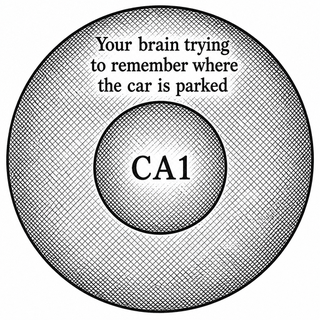
Imagine a circle. Now put a smaller circle inside it. Label the big circle "your brain trying to remember where the car is parked" and the little circle "CA1," a strip of hippocampus that acts like the bouncer and mildly judgmental floor manager of spatial memory. That little circle is where Petroccione and colleagues found glutamate receptors quietly helping tune the room.
The Memory Bar Has House Rules
CA1 is famous because many of its pyramidal neurons behave like place cells. A place cell fires when an animal is in a particular spot, which is basically the brain saying, "You are here, please stop pretending you have a sense of direction." These cells help build internal maps, and recent work keeps showing that the maps are flexible, moody, and not a laminated mall directory. Studies in Nature, Neuron, and Nature Neuroscience have shown that local circuit dynamics, inhibition, reward, and experience can reshape hippocampal spatial codes (Geiller et al., 2022; Rolotti et al., 2022; Sosa et al., 2025).
Now enter mGluRIII receptors. These are group III metabotropic glutamate receptors, meaning they do not pass ions like a fast electrical gate. They are more like the bar manager who hears one complaint, vanishes into the office, and changes staffing policy ten minutes later. Reviews describe mGlu receptors as modulators of learning, memory, and drug development targets, not decorative molecular furniture (Gregory and Goudet, 2021).
The Calcium Plot Twist
The old story said mGluRIII receptors in hippocampal CA1 suppress neurotransmitter release only at certain synapses, especially in a target-cell-specific way. In plain English: scientists thought these receptors were picky. They affected some incoming messages but left others alone.
Petroccione and colleagues asked a wonderfully annoying question: what if the lab setup nudged the answer? Many brain-slice experiments use extracellular calcium levels higher than brain tissue actually sees. Calcium matters because synapses use it to release neurotransmitter. If calcium is the bartender's pour spout, too much calcium means every drink comes out heavy-handed.
When the researchers lowered extracellular calcium to a more physiological level, the hidden effect appeared. mGluRIII receptors suppressed inhibition onto CA1 pyramidal cells too (Petroccione et al., 2026). That matters because inhibition, mostly carried by GABA, is not just the brain's brake pedal. It is the timing system for the jazz band. Without it, the trumpet solos never end.
Tiny Vesicle Logistics, Big Map Problems
The mechanism was not vague hand-waving, thank goodness. The team traced the effect to presynaptic release machinery. mGluRIII activation reduced the readily releasable pool, the set of vesicles docked and ready to dump neurotransmitter. Real talk: every synapse has a little stash behind the counter, and these receptors shrink the stash.
That shrinkage involved protein kinase A and synapsins, proteins that help manage vesicle availability. So the receptors were not merely whispering "calm down" at the synapse. They were changing inventory control.
Then the authors went beyond slices. Using in vivo whole-cell recordings in behaving mice, they interfered with glutamate spillover or blocked mGluRIII receptors in intact CA1 networks. Place-cell activity got disrupted. That links a molecular synapse-level mechanism to the animal's internal map. It is one thing to find a weird switch in the basement. It is another to flip it and watch the GPS start lying.
Why This Is More Than Synapse Trivia
This paper challenges a quiet assumption baked into years of slice physiology: the recipe in the dish can change the story. If higher-than-physiological calcium masks mGluRIII effects, then some "rules" about synaptic specificity may be partly rules about the experiment. Honestly, that is humbling in the way science often is, by walking in late, ordering water, and ruining everyone's confidence.
The possible impact is practical. If these findings reproduce and expand, researchers may need to rethink how group III mGlu receptors shape CA1 inhibition, place-cell stability, and spatial memory. It could also sharpen how scientists approach glutamate-based therapies. Glutamatergic signaling is already implicated in cognitive disorders, including Alzheimer's disease, where a 2024 systematic review found broad glutamatergic abnormalities across human brain studies (Soares et al., 2024). This CA1 work does not give us a treatment. No one should ask the pharmacy for "one hippocampus cocktail, shaken, not stirred." But it points to a subtler target: not just more or less glutamate, but where, when, and under what conditions glutamate tunes inhibition.
The brain's maps depend on balance. Excitation draws the route. Inhibition keeps the route from becoming a karaoke night with no closing time. mGluRIII receptors, it turns out, may be helping decide how loud the room gets before memory loses the plot.
Disclaimer: The image accompanying this article is for illustrative purposes only and does not depict actual experimental results, data, or biological mechanisms.
References
Petroccione MA, Melone M, Rathwell TJ, Dwivedi N, Grienberger C, Conti F, Scimemi A. An unsuspected physiological role for mGluRIII glutamate receptors in hippocampal area CA1. Cell Reports. 2026;45(6):117388. doi:10.1016/j.celrep.2026.117388
Gregory KJ, Goudet C. International Union of Basic and Clinical Pharmacology. CXI. Pharmacology, signaling, and physiology of metabotropic glutamate receptors. Pharmacological Reviews. 2021;73(1):521-569. doi:10.1124/pr.119.019133
Geiller T, Sadeh S, Rolotti SV, et al. Local circuit amplification of spatial selectivity in the hippocampus. Nature. 2022;601(7891):105-109. doi:10.1038/s41586-021-04169-9, PMCID: PMC9746172
Rolotti SV, Ahmed MS, Szoboszlay M, et al. Local feedback inhibition tightly controls rapid formation of hippocampal place fields. Neuron. 2022;110(5):783-794.e6. doi:10.1016/j.neuron.2021.12.003, PMCID: PMC8897257
Sosa M, Plitt MH, Giocomo LM. A flexible hippocampal population code for experience relative to reward. Nature Neuroscience. 2025;28(7):1497-1509. doi:10.1038/s41593-025-01985-4, PMCID: PMC12229899
Soares C, Da Ros LU, Machado LS, et al. The glutamatergic system in Alzheimer's disease: a systematic review with meta-analysis. Molecular Psychiatry. 2024;29(7):2261-2273. doi:10.1038/s41380-024-02473-0