
Logan's eyebrow-raiser was not that attention gets worse when a task gets crowded; it was that the same "load" effects can pop out of models with unlimited capacity, limited capacity, and fixed capacity. That is a theorist's cave-wall moment. In Imagine No Resources, Gordon Logan asks a rude but useful question: what if attention is not a scarce substance you pour onto things, but a way of choosing what gets amplified, muted, and politely escorted out of the neural nightclub? (Logan, 2026)
The Old Bucket Theory Had a Good Run
For decades, attention often sounded like a household budget. You had only so much of it. Spend too much on one thing, and the rest of cognition has to live on instant noodles. Bottleneck and resource theories gave psychology useful filters and mental-effort stories; they helped explain why texting while driving is less "productive citizen" and more "small tragedy rehearsing in public."
But Logan points out a problem hiding in the basement: saying attention is "limited capacity" does not explain why it is limited, or what the capacity is doing in the computation. It is like saying the ship of Theseus sank because it ran out of shipness.
Selection, Not Sprinkle Dust
Logan's alternative is sharper: attention is selection for action. You have goals, the world throws a confetti cannon of possible information at you, and your cognitive system chooses which representations matter next. Neurons are not waiting for a mystical resource grant from the Department of Mental Funding; they are competing, cooperating, and getting their signals scaled.
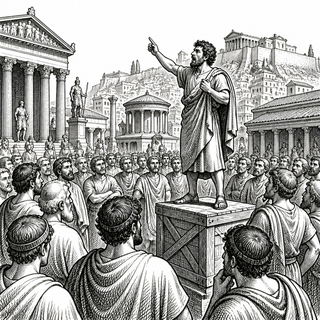
That scaling is called gain control. If the brain were an ancient agora, attention would not be the town's limited olive oil supply; it would be the loud citizen standing on a crate making one argument easier to hear. Annoying, but effective.
Normalization: The Brain's Bouncer
The second half of Logan's proposal is normalization. In neuroscience, divisive normalization means a signal gets divided by nearby activity, so no neural response becomes emperor just because it wore a shiny toga. Translation: the brain often reads signals relative to context, not as raw volume knobs.
This matters because normalization can make performance look capacity-limited without requiring a literal resource bucket. Recent work backs the idea that normalization is not just decorative math. Denison, Carrasco, and Heeger modeled temporal attention as a dynamic gain-and-recovery process (Denison et al., 2021). Doostani and colleagues found that normalization predicted human visual-cortex responses during object-based attention better than simpler sum or average models, especially when attention moved between overlapping objects (Doostani et al., 2023; PMCID: PMC10229119).
So yes, your brain may not be rationing attention like wartime sugar. It may be running a ranking system, which is both more elegant and more insulting.
Choice Was Hiding in the Attention Lab
The most intriguing move is Logan's claim that attention is choice. Not "paper or plastic," but: which representation gets to steer behavior? That connects attention to decision science, AI, learning, and value-based choice.
Recent reviews have been moving the same furniture around the room. Pearson and colleagues argue that value can capture attention, and attention can then push decisions, a loop relevant to addiction, advertising, and that cookie you definitely were not going to eat (Pearson et al., 2022). Wedel and colleagues show that gaze gives researchers a window into choice, because where you look often changes what you choose (Wedel et al., 2023). Denison's 2024 review makes the larger point from another angle: attention is dynamic and computational, not a static spotlight bolted to the skull (Denison, 2024).
Why This Is More Than Academic Chair Jousting
If Logan is right, attention science gets a cleaner question. Instead of asking "how much attention is left in the tank?" researchers can ask "what information is being selected, amplified, normalized, and converted into choice?" That shift could improve models of distraction, interface design, education, clinical attention problems, and AI systems that need priorities.
It also gives real-world debates about distraction a better skeleton. The National Highway Traffic Safety Administration reported 3,208 distracted-driving deaths in 2024, a brutal reminder that attention theory eventually gets behind the wheel. "Resources" talk got us far. But maybe it was a useful map with the hard terrain left blank.
Attention, in this view, is less a candle flame and more a courtroom. Signals make claims; goals cross-examine them; normalization keeps anyone from yelling "objection" forever. The verdict becomes behavior. What you call "focus" may be choice wearing a lab coat and trying very hard not to look metaphysical.
Disclaimer: The image accompanying this article is for illustrative purposes only and does not depict actual experimental results, data, or biological mechanisms.
References
Logan, G. D. (2026). Imagine No Resources: Attention Is Selection and Normalization for Choice. Perspectives on Psychological Science. https://doi.org/10.1177/17456916261446902
Denison, R. N., Carrasco, M., & Heeger, D. J. (2021). A dynamic normalization model of temporal attention. Nature Human Behaviour, 5, 1674-1685. https://doi.org/10.1038/s41562-021-01129-1
Doostani, N., Hossein-Zadeh, G.-A., & Vaziri-Pashkam, M. (2023). The normalization model predicts responses in the human visual cortex during object-based attention. eLife, 12, e75726. https://doi.org/10.7554/eLife.75726
Pearson, D., Watson, P., Albertella, L., & Le Pelley, M. E. (2022). Attentional economics links value-modulated attentional capture and decision-making. Nature Reviews Psychology, 1, 320-333. https://doi.org/10.1038/s44159-022-00053-z
Wedel, M., Pieters, R., & van der Lans, R. (2023). Modeling Eye Movements During Decision Making: A Review. Psychometrika, 88, 697-729. https://doi.org/10.1007/s11336-022-09876-4
Denison, R. N. (2024). Visual temporal attention from perception to computation. Nature Reviews Psychology, 3, 261-274. https://doi.org/10.1038/s44159-024-00294-0