
So here's what nobody tells you about brain inflammation: sometimes the biggest risk is not the invader, but the way the security system reprices the whole market after one bad trade. In neonatal meningitis, bacteria like neonatal meningitis-causing Escherichia coli do not politely knock on the blood-brain barrier. They stress the cells guarding it, the guards hit the molecular panic button, and suddenly the brain's border control starts behaving like a bank run with cytokines.
That is the market crash described in a new Cell Reports study by Zheng and colleagues. The team studied how infection pushes brain endothelial cells, the cells lining the blood vessels of the blood-brain barrier, into pyroptosis, a dramatic form of inflammatory cell death. Pyroptosis is not cells quietly retiring after a long career. It is more like a worker rage-quitting by kicking holes in the office walls, setting off alarms, and forwarding one last email to everyone in the building.
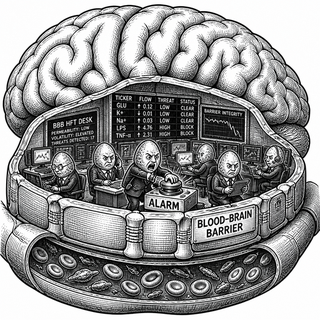
The Barrier Is Not Just a Wall
The blood-brain barrier, or BBB, is often described as a wall around the brain. Fine, but that undersells the job. It is more like a high-frequency trading desk for biology: nutrients in, toxins out, immune access tightly priced, no weird packages from the bloodstream unless someone has checked the invoice twice.
In bacterial meningitis, that pricing system fails. Once the BBB leaks, bacteria, immune molecules, and inflammatory signals can flood into places where the brain would strongly prefer everyone use indoor voices. That helps explain why meningitis is so dangerous in newborns. Even when antibiotics control the infection, inflammation can still leave a nasty balance sheet: seizures, hearing loss, developmental problems, and other neurological fallout.
The puzzle has been how the breach spreads. Is it just direct bacterial damage? Or does the brain's own immune response start amplifying the loss?
Zheng's team points to amplification.
Pyroptosis: The Cell Death With Terrible Table Manners
The researchers found that NMEC infection drives brain endothelial cells into GSDMD-dependent pyroptosis. GSDMD, or gasdermin D, is the protein that forms pores in the cell membrane after inflammatory enzymes cut it loose. Think of it as the contractor who was hired for emergency ventilation and accidentally removed the load-bearing wall.
The team then layered several high-resolution approaches: spatiotemporal single-cell transcriptomics, epigenomics, and proteomics. Translation: they did not just ask "which genes changed?" They asked which cells changed, when they changed, what regulatory switches opened, and which proteins showed up to do the dirty work. As one does, if one has a Tuesday and a very large sequencing bill.
One standout was Gbp5, which the paper identifies as a key regulator of endothelial pyroptosis. In game theory terms, Gbp5 may help decide when an infected border cell defects from "maintain the barrier" to "blow the whistle by blowing up." That trade may help alert the immune system, but the cost is steep when the cell is part of the brain's customs office.
Then Microglia Buy the Panic
Here is the really interesting part: the damage did not stay local. Pyroptotic endothelial cells appeared to push nearby microglia, the brain's resident immune cells, toward pyroptosis too. The signal route involved Angptl4-Sdc4 communication.
That matters because microglia are supposed to be the brain's in-house risk managers. They patrol, prune, clean, and react. But if endothelial cells send the wrong inflammatory market signal, microglia may stop acting like disciplined analysts and start shorting the whole neighborhood.
The authors call this a pyroptosis cascade between endothelial cells and microglia. That phrase sounds fancy, but the idea is very practical: one class of cells gets inflamed, dies loudly, and recruits another class of cells into the same bad behavior. The border falls, the alarm spreads, and the brain pays the transaction fees.
Why This Could Matter
If these findings hold up across models, strains, and eventually human-relevant systems, they could shift how scientists think about treating bacterial meningitis. Antibiotics kill bacteria, but they do not automatically clean up the inflammatory trading floor after the crash. A therapy that dampens the pyroptosis cascade, blocks specific gasdermin D activity, tunes Gbp5-related signaling, or interrupts Angptl4-Sdc4 cross-talk might help protect the BBB while antibiotics handle the pathogen.
That is not a treatment recommendation. It is a research road map. The brain is not a spreadsheet, sadly, because then somebody would have found the "undo" button by now. Any anti-inflammatory strategy would need exquisite timing. Too little immune response, and bacteria get a discount pass. Too much, and the BBB turns into a poorly managed border checkpoint during peak travel.
Other recent work supports the broader logic. Studies have linked meningitic E. coli to endothelial pyroptosis and tight-junction damage, caspase-4/11-driven BBB injury through VEGFA/VEGFR2 signaling, and microglial gasdermin D activation in BBB dysfunction. Meanwhile, pyroptosis reviews keep making the same uncomfortable point: inflammatory cell death is not just cleanup after infection. It can become part of the disease engine.
The takeaway is sharp. In neonatal meningitis, the brain's defense system may face a brutal cost-benefit problem: signal danger fast, but do not destroy the exchange where all the signals travel. Zheng and colleagues suggest that the BBB and microglia can get trapped in a bad feedback loop, where each round of inflammatory signaling makes the next round easier.
That is the kind of biological market failure worth understanding before it liquidates the most expensive asset on the books.
References
- Zheng Y, Wu Z, Wu F, Hu H, Ma J, Zhang G, Sun H, Li X, Cheng H, Xiong H. The pyroptosis cascade between inflammatory endothelial cells and microglia facilitates BBB disruption in bacterial meningitis. Cell Reports. 2026;45(7):117634. doi:10.1016/j.celrep.2026.117634
- Jia K, Du Y, Cao X, Shen X, Ran J, Lu Y, Peng L, Li Z, Fang R. Meningitic Escherichia coli disrupts the blood-brain barrier through pyroptosis and tight junction degradation and NLRP6 deficiency aggravates infection outcomes. Microbiological Research. 2026;303:128388. doi:10.1016/j.micres.2025.128388
- Du Y, Yu X, Lu Y, Jia K, Peng L, Fang R, Zhang J, Li Z. Caspase-4/11-mediated non-canonical pyroptosis disrupts blood-brain barrier integrity via VEGFA/VEGFR2 signaling in Escherichia coli meningitis. Microbiological Research. 2026;309:128531. doi:10.1016/j.micres.2026.128531
- Ha S, Yu J, Ku B, et al. Microglial NLRP3-gasdermin D activation impairs blood-brain barrier integrity through neutrophil recruitment in traumatic brain injury. Nature Communications. 2025;16:949. doi:10.1038/s41467-025-56097-1
- Cai K, Wang Z, Liao R, et al. Delaying pyroptosis with an AI-screened gasdermin D pore blocker. Nature Immunology. 2025. doi:10.1038/s41590-025-02280-x
- Li Y, Yuan Y, Huang ZX, et al. Pyroptosis: mechanisms and links to disease. Cell Research. 2025. doi:10.1038/s41422-025-01107-6
Disclaimer: The image accompanying this article is for illustrative purposes only and does not depict actual experimental results, data, or biological mechanisms.